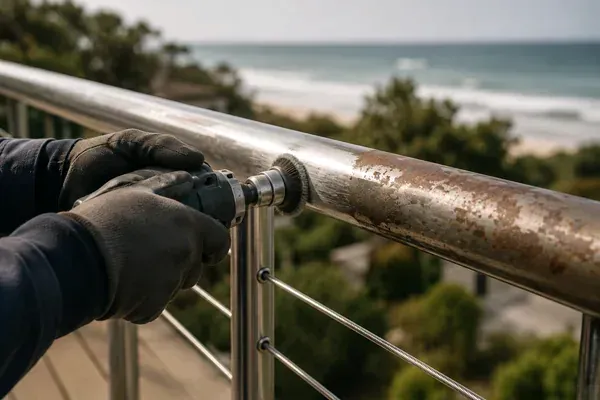
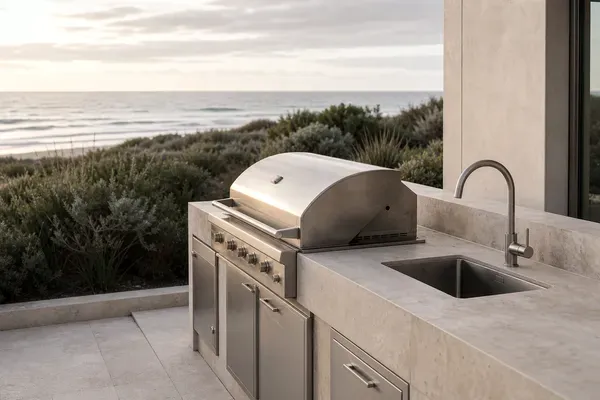
Does Stainless Steel Rust Near the Coast?
Yes, even stainless rusts in WA salt air. Learn why outdoor stainless stains and corrodes on the coast, and how to clean, protect and prevent it.
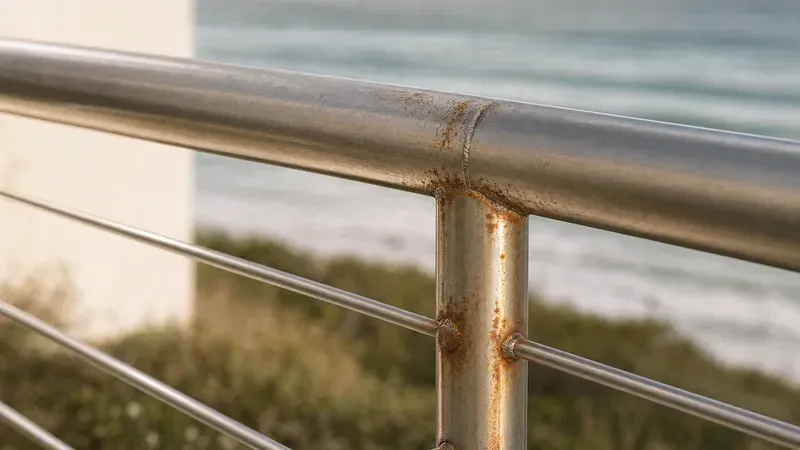
Does stainless steel rust near the coast?
Yes. Near the ocean, airborne salt attacks the thin chromium-oxide layer that makes stainless steel “stainless,” so it stains and corrodes anyway, the orange-brown “tea-staining” seen on coastal balustrades, BBQs and outdoor lighting. It isn’t a fault or a cheap product. It’s the salt air, and it’s preventable with the right routine. See your suburb’s AS 4312 corrosivity zone to see how hard your own property is likely to get hit.
Why people think stainless “can’t” rust
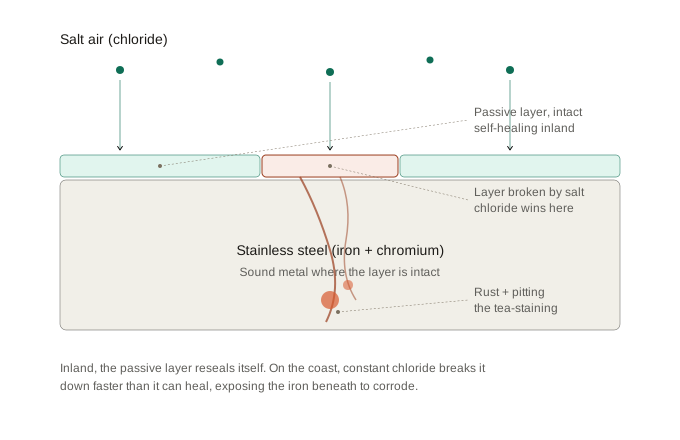
Stainless steel resists rust because of one feature: a microscopic layer of chromium oxide that forms on the surface and seals the metal underneath. Scratch it and, in normal conditions, it heals itself using oxygen from the air. That’s the whole trick, and it’s why stainless earns its name almost everywhere inland.
The belief that stainless never rusts comes from those inland conditions, where the self-healing layer is left alone to do its job. It’s true enough in a kitchen or a suburb ten kilometres back from the water. It stops being true at the beach.
What salt air actually does to it
Salt air carries chloride. Chloride is the one thing that protective chromium-oxide layer can’t shrug off: it breaks the layer down faster than it can rebuild, and once there are gaps, the iron in the steel is exposed and starts to corrode. The result is the rust-coloured staining and pitting coastal homeowners know well, on handrails, fasteners, screws, light fittings and BBQ surfaces.
Two things make it worse on the WA coast specifically. First, the grade of stainless matters enormously: 304 stainless, which is fine indoors and common on budget fittings, tea-stains readily within sight of the surf, while 316 (“marine grade”) holds up far better but still needs maintenance. Second, salt that lands on a surface and is never rinsed off just keeps working: sheltered spots that rain doesn’t reach (under eaves, behind glass balustrade panels) often corrode faster than fully exposed ones, which catches people out.
How exposed is the WA coast, really?
Corrosion researchers grade how aggressive an environment is using the AS 4312 corrosivity scale, running from C1 (benign, indoors) up to C5 (very high, industrial or surf-front). Most of the WA coastline from Dawesville up to Two Rocks sits in C4 to C5, high to very high. That means coastal tea-staining here isn’t an occasional bad-luck event; it’s the baseline condition the metal is living in.
On C5 frontages within a couple of hundred metres of open surf, untreated 304 fittings can show tea-staining inside a single summer.
Is it permanent? Can you fix it?
In almost all cases, no, it isn’t permanent, and yes, it can be fixed. Surface tea-staining is exactly that, on the surface, so it cleans off and the metal underneath is usually sound. The job is to remove the staining without scratching the steel further, then restore the passive layer so it stops coming back. Deep pitting that’s been left for years is harder and sometimes can’t be fully reversed, which is the main argument for dealing with it early rather than waiting.
How to remove rust and tea-staining from stainless steel
- Rinse with fresh water first to lift loose salt and grit, so you’re not grinding it into the surface.
- Clean with a dedicated stainless cleaner or a mild non-chloride detergent and a soft cloth or non-scratch pad. Never use steel wool, wire brushes or chloride-based bleach: they scratch the surface or add the exact chemical causing the problem.
- Work along the grain of the steel, not across it, to avoid visible marks.
- For stubborn tea-staining, use a proprietary stainless cleaner or a passivating gel that removes staining and helps re-form the protective layer in one step.
- Rinse thoroughly and dry. Leftover cleaner or standing water undoes the work.
- Re-passivate or apply a protective treatment so the chromium-oxide layer is restored and the surface is sealed against the next round of salt.
How to stop it coming back
The honest answer is that on the coast you don’t “fix it once”, you manage it. A regular rinse-and-clean schedule (more often the closer you are to the surf), the right grade of steel where you can choose it, and a periodic protective treatment together keep stainless looking right instead of letting it slide into permanent pitting. The same principles apply to all your outdoor metal, not just stainless; our guide on protecting metal fixtures from coastal rust covers gates, railings and hardware. Salt doesn’t stop at metal: on porous surfaces like render it crystallises inside the material, the same mechanism covered in our guide to salt damage on rendered walls, and the white powdery deposits it leaves on masonry surfaces are a form of efflorescence worth knowing about. That maintenance rhythm is the whole reason coastal homes benefit from a scheduled care plan rather than a one-off clean.
Coastal stainless doesn’t need replacing, it needs a routine. A Salt Coast maintenance plan keeps your balustrades, fixtures and outdoor metal on a cleaning and protection schedule matched to how exposed your home actually is, so tea-staining never gets the chance to become pitting.
Common questions
FAQs
Will stainless steel rust in salt air?
Yes. Salt air carries chloride, which breaks down the protective chromium-oxide layer on stainless steel and lets the metal underneath corrode. It shows up as orange-brown tea-staining on coastal fittings, balustrades and BBQs, even on grades that never rust inland.
How do I remove rust from stainless steel?
Rinse with fresh water, then clean along the grain with a dedicated stainless cleaner or mild non-chloride detergent and a soft pad, never steel wool or chloride bleach. For stubborn staining, use a passivating cleaner that removes the marks and helps restore the protective layer, then rinse, dry and apply a protective treatment.
What's the difference between 304 and 316 stainless on the coast?
304 stainless is fine indoors and inland but tea-stains readily near the surf. 316, or “marine grade,” contains added molybdenum that resists chloride far better and is the right choice for coastal fittings, though even 316 needs regular cleaning to stay stain-free this close to the ocean.
How often should outdoor stainless be cleaned on the coast?
It depends on how close you are to open surf, but front-line coastal homes generally need stainless cleaned far more often than the “occasional wipe” most fittings get, think a regular scheduled rinse-and-clean rather than waiting for staining to appear. The closer to the water, the more often.
Is tea-staining covered by warranty or is it a defect?
Usually neither. Tea-staining is surface corrosion caused by the environment, not a manufacturing fault, so it’s generally not a warranty issue. It’s expected on the coast and is managed through maintenance, not replacement.